How long does it take to replace a roof?
How long does it take to replace a roof?
The Answer Homeowners Actually Want First
Let’s cut straight to it because this is what every homeowner is really asking.
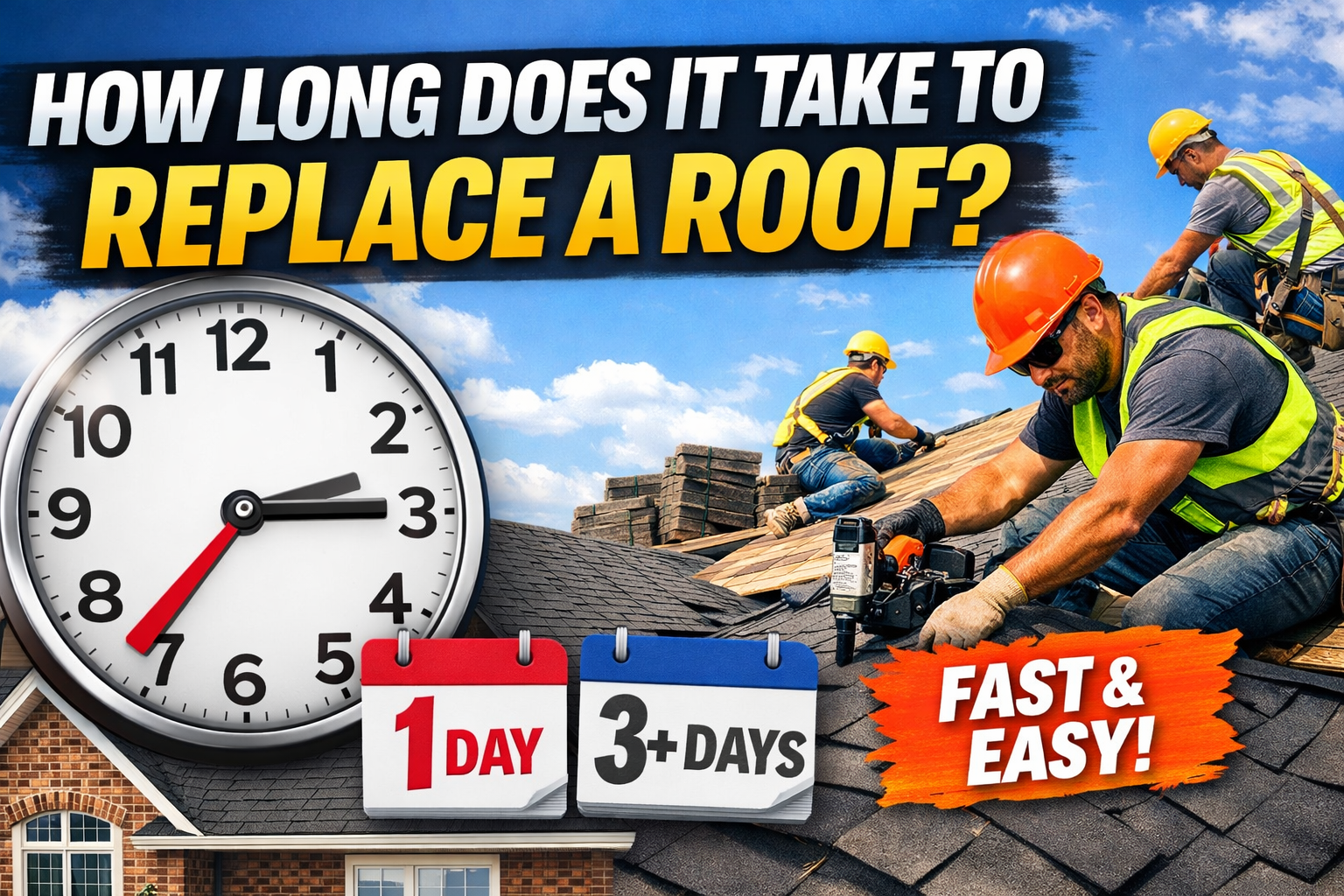
Most roof replacements take one to three days once the crew starts working.
That is the reality. Not weeks. Not some drawn out construction project that takes over your life. In most cases, your roof is removed, rebuilt, and cleaned up within a few days.
Now there are exceptions. A small and straightforward roof can be completed in a single day. On the other end, a larger or more intricate roof can stretch a bit longer. But for the average home, you are looking at a tight, efficient window measured in days.
The key detail people often miss is this. The speed of the job depends heavily on who is doing the work. An experienced team that knows how to plan, stage materials, and execute efficiently can compress what feels like a massive project into a smooth, controlled process. That is where a company like Sunrise Exterior stands out in Illinois. The difference is not just in how fast the job gets done, but in how predictable and stress free that timeline feels.
So if you are wondering how long this will disrupt your routine, the honest answer is simple. A few days on site is the norm when the job is handled the right way.
Why Some Roofs Take a Day and Others Take a Week
Here is where things get more interesting.
Two homes can sit side by side on the same street and have completely different roof replacement timelines.
One is done before dinner the next day. The other takes nearly a week. Same type of project on the surface, very different reality once the work begins.
The reason comes down to a handful of factors that quietly control everything.
Think of roof replacement less like a fixed service and more like a custom build. The shape of the home, the materials involved, and the condition of what is underneath all play a role in how long the process takes. There is no one size fits all timeline because no two roofs are truly identical.
What matters for homeowners is not memorizing every technical detail. It is understanding that the timeline is not random. It follows a pattern. Once you know what influences it, the entire process starts to make sense.
This is also where working with a seasoned roofing company becomes critical. Experienced teams do not guess timelines. They evaluate the structure, anticipate complications, and build a realistic plan before the first shingle is ever removed. That level of preparation is what keeps projects moving efficiently, even when variables come into play.
In the next section, we break down exactly what those variables are and how each one can speed up or slow down your roof replacement.
The Five Factors That Control Your Roof Timeline
This is where the timeline stops feeling random and starts making sense.
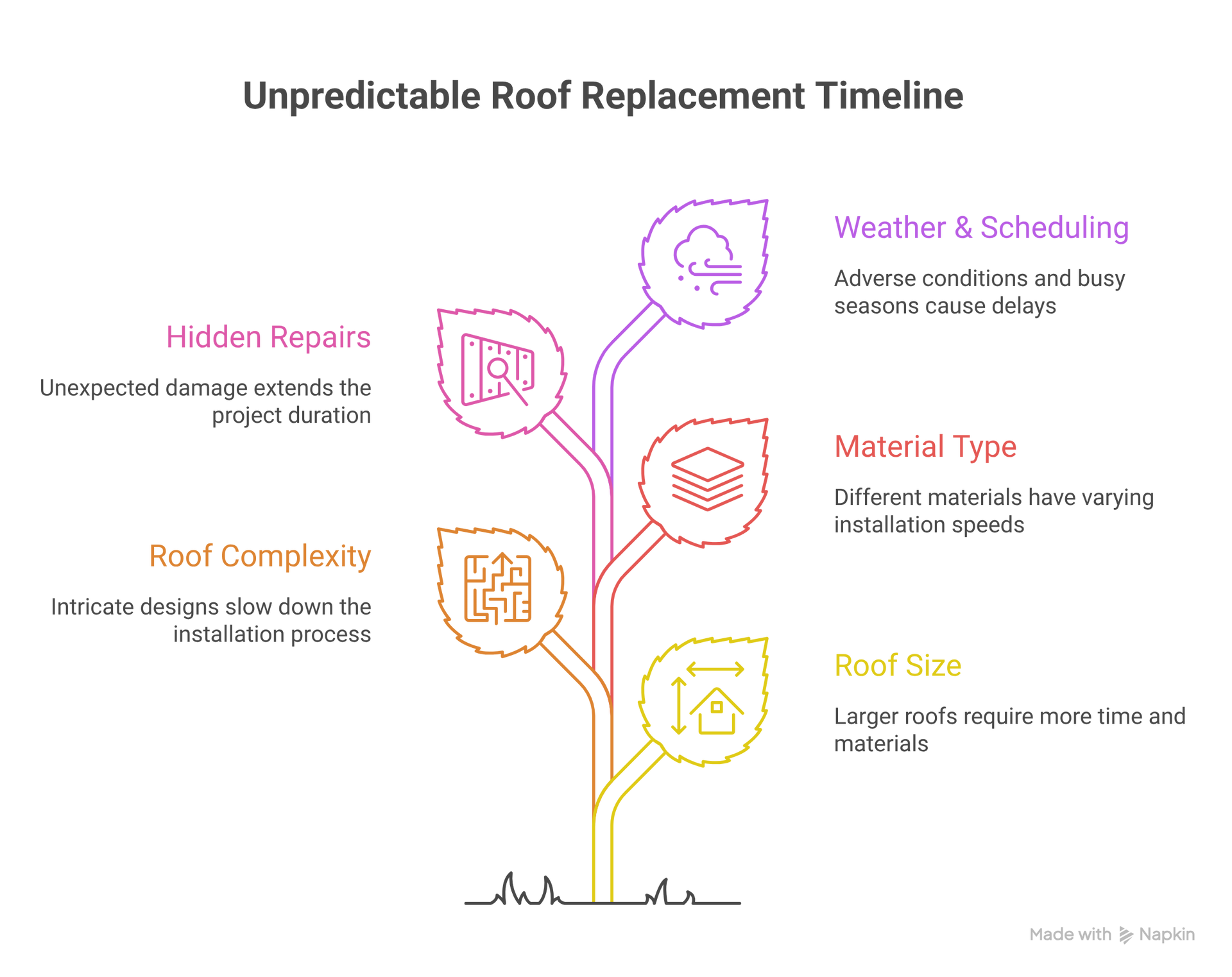
There are five core factors that quietly dictate how long your roof replacement will take. Once you understand these, you can almost predict the timeline before the first nail is ever set.
Roof size
Bigger roof, more work. It is that simple. More surface area means more material to remove, more material to install, and more time for the crew to move across the structure. A compact home can move quickly. A sprawling one naturally takes longer.
Roof complexity
This is where things really start to slow down. A clean, simple roofline is fast. Add valleys, dormers, skylights, or multiple levels and the pace changes. Every angle and intersection requires precision. Crews have to work more carefully, which adds time but protects the integrity of the roof.
Material type
Not all roofing materials move at the same speed. Asphalt shingles are the fastest and most common, making them ideal for quick turnarounds. Metal roofing requires more precision and handling. Tile and slate demand even more care, which extends the timeline but often delivers longer term durability.
Hidden repairs
This is the wildcard that no homeowner sees coming. Once the old roof is removed, the underlying structure is exposed. If the decking or flashing is damaged, it needs to be repaired before anything new goes on. This step cannot be rushed and it should not be skipped.
Weather and scheduling
Illinois weather does not always cooperate. Rain, wind, and temperature swings can pause progress. On top of that, busy seasons can affect when a crew is available to start and how efficiently the project flows. Timing matters more than most people expect.
Put all five together and the timeline becomes a moving equation. But in the hands of an experienced team like Sunrise Exterior, these variables are managed, not feared. That is the difference between a project that drags on and one that feels controlled from start to finish.
A Simple Breakdown by Roof Type and Size
Let’s make this easy to picture.
Most homeowners do not need a technical breakdown. They need a clear sense of where their home falls on the timeline. Here is the cleanest way to think about it.
A small and simple roof can often be completed in one day. These are straightforward projects with minimal complexity and easy access.
An average residential roof typically takes one to three days. This is where most homes land. Standard size, standard materials, and a crew that knows how to move efficiently.
A large or complex roof can take three to five days or more. Multiple levels, steep angles, and intricate designs require more time and attention.
Now layer in materials.
Asphalt shingles are the fastest option and usually fall within that one to three day window.
Metal roofing often takes two to five days because of the added precision during installation.
Tile or slate roofs take the longest, often five to seven days or more, due to their weight and the care required to install them properly.
The takeaway is simple. Most roofs are completed in just a few days, but the details of your home decide exactly where you land. And when those details are evaluated properly from the start, the timeline feels less like a guess and more like a plan.
What Actually Happens During Those Few Days
From the outside, a roof replacement can look like a blur of motion. Trucks pull up. Materials get stacked. Crews move with purpose. Then suddenly it is done.
But there is a clear sequence behind that speed.
First comes the tear off. The old roofing material is removed down to the decking. This is where the real condition of the roof is revealed.
Next is the inspection. The crew checks for any damage beneath the surface. If the decking or flashing shows wear, this is the moment it gets addressed.
Then comes the foundation layer. Underlayment and flashing are installed to protect against moisture and create a secure base for the new roof.
After that, the new roofing material goes on. This is the most visible part of the process, but it is only one piece of the full job.
Finally, cleanup and inspection. A well run crew leaves the property looking sharp, not like a construction site.
Nails are cleared, debris is removed, and the finished roof is checked for quality.
When you understand the steps, the timeline makes more sense. It is not rushed. It is structured.
Why the Right Roofing Company Makes the Timeline Predictable
Speed is impressive. Predictability is what actually matters.
A roof replacement should not feel chaotic. It should feel planned. That comes down to the team you hire.
An experienced company does more than show up and start working. They prepare. They assess the roof ahead of time, organize materials, coordinate labor, and anticipate potential issues before they become delays.
This is where Sunrise Exterior separates itself in Illinois. The goal is not just to complete the job quickly. The goal is to make the entire process feel controlled from start to finish. Homeowners know what to expect, when to expect it, and how the project will unfold.
That level of organization is what turns a few days of work into a smooth experience instead of a stressful one.
The Bottom Line Fast Project Long Term Investment
So how long does it take to replace a roof?
In most cases, just a few days.
That is the headline. But the real story is what those few days represent. A full reset of one of the most important parts of your home. Protection, performance, and peace of mind built in a short window of time.
The timeline is shaped by size, complexity, materials, and conditions beneath the surface. But with the right team, those variables are handled with precision, not guesswork.
Conclusion
If you are starting to think about replacing your roof, the next step is simple. Get clarity before the work begins.
Sunrise Exterior helps homeowners across Illinois understand exactly what to expect, from timeline to materials to final results. No surprises. No vague estimates. Just a clear plan and a team that knows how to execute it.
Reach out, get your roof evaluated, and turn what feels like a big project into a straightforward process that is done right the first time.
Recent Posts