What Adds 100,000 Dollars to Your House?
what adds 100,000 dollars to your house?

Introduction: Can You Really Add 100,000 Dollars to Your Home?
There is an irresistible idea in home improvement.
Spend 100,000 dollars renovating your house and suddenly your house is worth 100,000 dollars more.
Nice theory.
Real estate is considerably messier.
There is no single renovation that automatically adds 100,000 dollars to every house. Not a luxury kitchen. Not a primary suite. Not a finished basement. Not new siding. Not even a major addition.
The more realistic way to create a substantial increase in home value is usually to improve the property in several meaningful ways at once.
Add useful living space. Correct major defects. Improve functionality. Protect the exterior. Bring outdated areas closer to what buyers expect. Most importantly, make the house more competitive with properties selling for substantially more in the same market.
That last part changes everything.
Because ultimately, the question is not simply how much money you spend on your house.
The question is how much more buyers are willing to spend on your house after the work is finished.
Spending 100,000 Dollars Does Not Mean Adding 100,000 Dollars
Imagine you purchase a house worth 500,000 dollars.
You spend 150,000 dollars renovating it.
When the work is finished, comparable sales suggest the property is now worth 600,000 dollars.
Your house gained 100,000 dollars in market value.
But you spent 150,000 dollars creating that increase.
You did not make 100,000 dollars in profit.
You increased the value of the property by 100,000 dollars while spending more than that amount to accomplish it.
This distinction matters because homeowners often confuse project cost, added value, and return on investment.
They are not the same thing.
A renovation can make your home substantially more valuable without returning every dollar you spent.
It can also improve your daily life enormously while producing only a modest financial return.
Neither outcome necessarily makes the renovation a bad decision.
You simply need to know which result you are trying to achieve.
Stop Looking for the Magic Renovation
Search online and you will find endless claims about improvements that supposedly add enormous amounts of value.
The problem is that houses do not exist in a vacuum.
A bathroom addition might be extremely valuable in a neighborhood where comparable homes have three bathrooms and yours has one.
The exact same bathroom may contribute considerably less in a home that already has four.
A finished basement might dramatically improve one property.
Another buyer may place less value on it because similar homes in that market are valued primarily according to their above grade living area.
A garage can be extremely desirable where parking is difficult.
In another location, it may be merely convenient.
Context decides.
The Better Question Is Worth 100,000 Dollars
Instead of asking, “What renovation adds 100,000 dollars?”
Ask this:
What separates my house from nearby houses selling for 100,000 dollars more?
That is a far more useful question.
Perhaps those homes have another bedroom.
Maybe they have two and a half bathrooms while yours has one.
Perhaps they have finished basements.
Maybe their kitchens are substantially more functional.
Their exteriors may be in better condition.
Their roofs may have more useful life remaining.
They might have garages, better layouts, newer major systems, or additional usable living space.
Suddenly, adding value becomes less mysterious.
You are no longer guessing which renovation sounds impressive.
You are identifying what the market is already rewarding.
Illinois Homeowners Should Think From the Outside In
For homeowners in Illinois, there is another important consideration.
Before spending heavily on luxury improvements inside the house, make sure the house itself is protected.
Illinois weather can be demanding on residential exteriors.
Rain, snow, wind, storms, freezing temperatures, summer heat, and constant seasonal changes all place stress on roofs, siding, gutters, windows, doors, flashing, and other exterior components.
A beautiful new kitchen underneath a leaking roof is not a strong investment.
A newly finished basement does not feel nearly as valuable if water enters after heavy rain.
Expensive interior finishes cannot compensate for serious exterior deterioration forever.
That is why an Illinois home improvement company such as Sunrise Exteriors can play an important role in a larger home value strategy.
Before asking how to make the house more luxurious, it can make sense to ask whether the exterior is doing its most important job.
Protecting everything you are about to invest in.
What Actually Determines How Much Value a Renovation Adds?
Homeowners keep receipts.
Appraisers look at markets.
That difference explains a great deal about renovation value.
If you spend 80,000 dollars on a project, an appraiser does not normally look at the invoice and automatically increase the value of your property by 80,000 dollars.
The market has to support the improvement.
Fannie Mae appraisal guidance emphasizes that adjustments between a property and comparable sales should reflect market reaction to those differences.
In simpler language, buyers have the final vote.
If buyers consistently pay substantially more for homes with a particular feature, that feature may contribute meaningful value.
If buyers barely pay more for it, your construction bill does not change that reality.
Comparable Homes Matter More Than Your Receipts
Suppose you spend 120,000 dollars creating an elaborate addition.
You use beautiful materials.
The workmanship is excellent.
Everything is permitted.
There is only one problem.
Homes similar to yours in the neighborhood rarely sell above 550,000 dollars, and your house was already worth approximately 500,000 dollars before construction.
You may have built a fantastic addition.
You have not necessarily created a 620,000 dollar house.
The local market may simply not support that price.
Now imagine another situation.
Your home has three bedrooms and one bathroom.
Comparable properties nearby have three bedrooms, two bathrooms, finished basements, maintained exteriors, and more functional layouts.
Those properties regularly sell for considerably more.
Correcting several of those deficiencies may move your property into a different competitive position.
That is where substantial value increases become more realistic.
Your Starting Condition Matters
A renovation can have a very different impact depending on where the property begins.
Replacing perfectly functional siding because you prefer another color is different from replacing siding that is severely deteriorated.
Updating a usable kitchen from five years ago is different from replacing a damaged kitchen that has not been meaningfully updated in forty years.
Replacing a healthy roof for aesthetic reasons is different from replacing a roof with active leaks and very little remaining useful life.
The worse the starting condition, the more an improvement may help remove buyer objections.
Sometimes a project is not creating entirely new value.
It is recovering value that poor condition was already suppressing.
That distinction becomes especially important with roofing and other major exterior components.
Bedrooms and Bathrooms Matter in Context
The number of bedrooms and bathrooms can significantly affect how buyers compare homes.
But again, context controls the answer.
Adding a fourth bedroom may be valuable in a neighborhood where four bedroom homes command a noticeable premium.
Adding a sixth bedroom may produce a much smaller effect if buyers in that area have little demand for it.
Bathrooms can work similarly.
A three bedroom house with one bathroom may have a functional disadvantage compared with nearby properties offering two or three.
Adding another bathroom can therefore improve more than appearance.
It changes how the house functions.
Useful Living Space Can Change the Equation
Adding legitimate, functional living space can be one of the more powerful ways to change a property.
A family room.
A bedroom.
A primary suite.
A finished attic.
A legal basement conversion.
An accessory dwelling unit where permitted and supported by the market.
The key words are legitimate and functional.
Simply making an unfinished area look attractive does not guarantee that buyers, appraisers, lenders, or local authorities will treat it the same way as recognized living space.
Permits matter.
Building requirements matter.
Safe access matters.
Ceiling height can matter.
Heating, cooling, insulation, ventilation, egress, zoning, and occupancy rules can matter.
The value of additional space becomes much easier to defend when the space was created properly.
Construction Quality Matters
There is also a difference between adding space and adding good space.
A poorly designed addition can make the original house worse.
Rooms may feel awkward.
Traffic patterns may become strange.
Windows may disappear.
The exterior may look patched together.
Heating and cooling may become inconsistent.
A good addition should feel as though it belongs to the house.
Fannie Mae guidance recognizes the importance of improvements fitting expectations for design, materials, size, quality, and condition within the competitive market.
This does not mean every home must look identical.
It means unusual improvements can face resistance when buyers do not see enough value in them.
The Neighborhood Price Ceiling Matters
This may be the most expensive lesson in remodeling.
Every neighborhood has some relationship between what homes typically offer and what buyers are typically willing to pay.
That does not mean there is a perfectly fixed maximum price.
Exceptional properties can certainly sell above expectations.
But homeowners should be cautious about spending as though neighborhood context does not exist.
If comparable properties cluster around 400,000 dollars, spending 250,000 dollars trying to create a luxury property may be financially difficult to justify.
The same project could make considerably more sense in a neighborhood where comparable renovated homes sell for 900,000 dollars.
The construction cost might be similar.
The market response could be completely different.
Permits Can Affect More Than Paperwork
Permits are easy to dismiss as bureaucracy until it is time to sell.
An addition without required permits can create questions about construction quality, safety, legality, insurance, financing, and marketability.
Buyers may wonder whether electrical work was inspected.
They may question plumbing.
They may wonder whether a bedroom legally qualifies as one.
An appraiser may need to address the unpermitted addition and its effect on value.
When the objective is creating significant home value, uncertainty is the enemy.
Proper documentation helps reduce it.
Buyer Demand Is the Final Test
Ultimately, improvements become valuable because buyers value them.
That sounds obvious, but it is frequently forgotten during expensive renovation projects.
Homeowners naturally choose features based on personal preference.
Buyers make decisions based on theirs.
The closer those preferences align, the better the opportunity for resale value.
This is why broadly useful improvements often deserve serious consideration.
Functional living space.
Appropriate bathroom count.
A practical kitchen.
A healthy roof.
A maintained exterior.
Reliable major systems.
Useful storage.
Adequate parking.
Comfort.
Efficiency.
These features solve everyday problems.
And everyday usefulness tends to have a broader audience than extravagance.
For Illinois homeowners considering a major investment, the smartest starting point may therefore be surprisingly simple.
Look at the homes selling for 100,000 dollars more.
Study what they have.
Study what yours lacks.
Then decide which improvements can close that gap without spending more money than the market is likely to recognize.
For exterior weaknesses involving roofing, siding, gutters, windows, doors, or related components, Sunrise Exteriors can fit into that strategy by helping homeowners address the protective shell of the property before larger investments are made elsewhere.
Because adding value starts with improving the house.
Protecting value starts with making sure the house underneath those improvements remains sound.Here are Sections 3 and 4 only, continuing the same style and avoiding all hyphen and dash punctuation.
The Most Realistic Way to Add 100,000 Dollars Is to Change the Home’s Market Position
If you want to add 100,000 dollars in value, stop thinking like a shopper.
Think like a buyer.
A homeowner might look at one project and ask, “How much value will this add?”
A buyer looks at the whole property and asks, “How does this house compare with everything else I can buy?”
That difference is crucial.
The strongest path toward a major increase in value is often not one spectacular renovation.
It is changing the category your home competes in.
Ask What Higher Priced Homes Have That Yours Does Not
Suppose homes similar to yours are selling for 500,000 dollars.
Then you notice another group nearby consistently selling closer to 600,000 dollars.
Do not begin with renovation ideas.
Begin with differences.
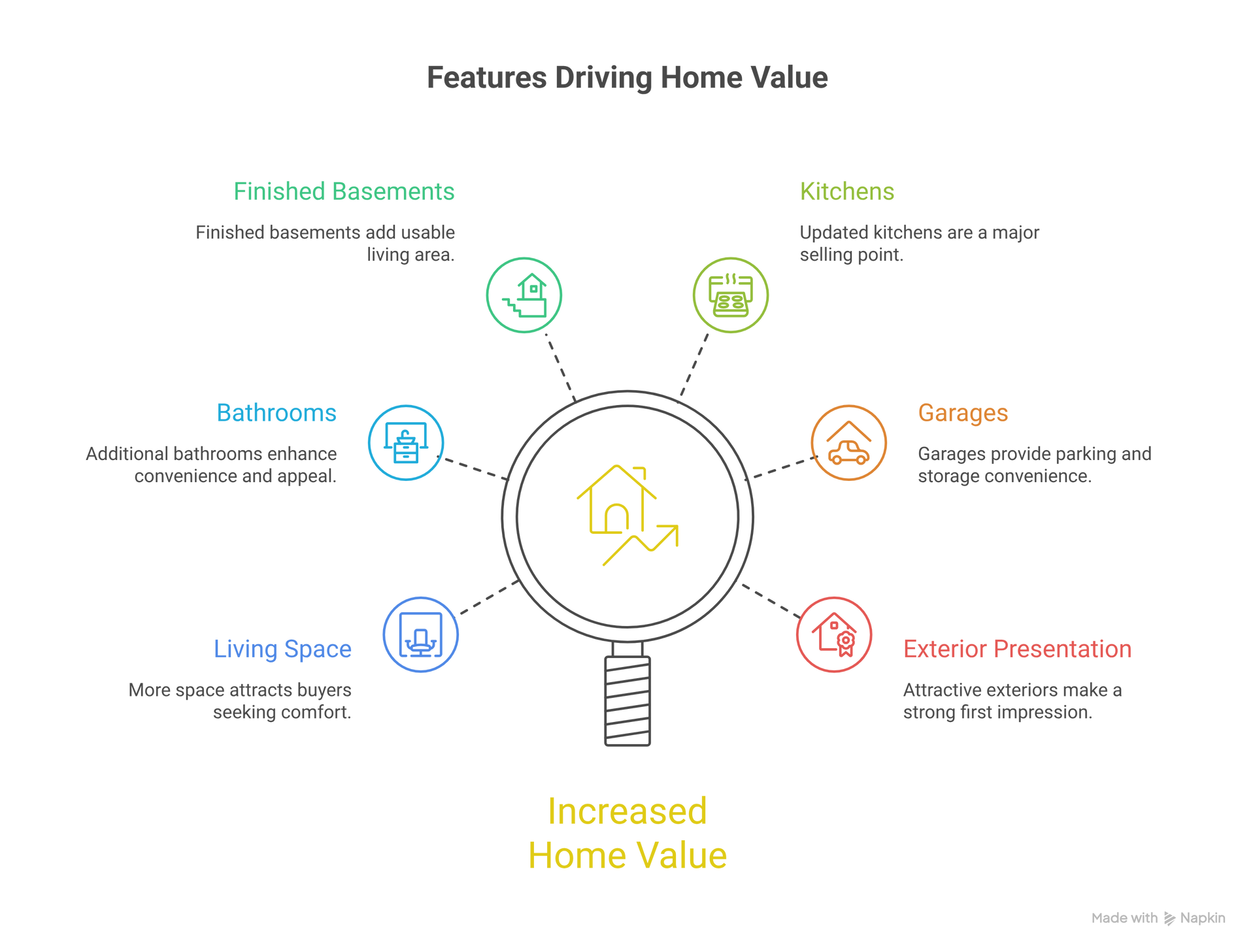
Do the higher priced homes have more living space?
Another bathroom?
Finished basements?
Better kitchens?
Garages?
Newer roofing?
Better maintained siding?
More functional layouts?
Updated mechanical systems?
Better exterior presentation?
You are looking for patterns.
If the same features repeatedly appear in homes selling for significantly more, those features may tell you where buyers are assigning value.
Correcting Weaknesses Can Be More Powerful Than Adding Luxury
A house does not always need something extravagant.
Sometimes it simply needs to stop being the house with the obvious disadvantages.
Imagine a three bedroom property with one bathroom, an unfinished basement, a failing roof, and an outdated kitchen.
You could spend heavily creating an extraordinary kitchen.
That would certainly improve one room.
But the house would still have one bathroom.
The basement would still be unfinished.
The roof would still worry buyers.
Now consider another approach.
Address the roof.
Add a functional bathroom where appropriate.
Finish usable space legally.
Improve the kitchen enough to meet neighborhood expectations.
Suddenly, you have not simply upgraded the house.
You have repositioned it.
That can be far more important.
From Below Average to Competitive
One of the most valuable transformations in real estate is moving a property from below local expectations toward the middle or upper end of what buyers expect.
A house with badly deteriorated siding may feel neglected.
Replacing or properly addressing that deterioration can help move it closer to neighboring homes that look maintained.
A house with too few bathrooms may feel functionally outdated.
Adding one can make it compete with more properties.
A home with an unfinished lower level may offer less usable space than nearby alternatives.
Converting that space properly can make the comparison more favorable.
The point is not that each project has a fixed dollar value.
The point is that several strategic improvements together can change how the market categorizes the property.
The Complete Home Often Wins
Buyers frequently pay for confidence.
A house that feels complete, maintained, functional, and ready to occupy can be more attractive than a property with one spectacular feature and several obvious weaknesses.
That is why expensive showpiece renovations can sometimes disappoint financially.
A 70,000 dollar kitchen inside a home with a leaking roof and damaged siding sends mixed signals.
The kitchen says luxury.
The exterior says future expense.
Buyers notice both.
A more balanced improvement plan may create a stronger overall impression.
For Illinois homeowners, that often means making sure the exterior is not undermining the interior.
Roofing, siding, gutters, windows, doors, and other exterior components may not be as glamorous as a designer kitchen, but they affect how protected and maintained the property feels.
This is one reason Sunrise Exteriors can fit naturally into a larger home value plan.
If exterior problems are holding the property back, correcting them may help the rest of the house compete more effectively.
Adding Legal Living Space Can Create Significant Value
If there is one category of improvement capable of meaningfully changing a house, it is adding useful living space.
You are not simply making an existing room prettier.
You are giving buyers more house.
That can change how the property is compared, how families use it, and in some markets, how much buyers are willing to pay.
But there is an important word in that sentence.
Useful.
Not All Square Footage Is Equal
Adding 500 square feet does not automatically create the same value everywhere.
The quality and purpose of the space matter.
A well designed family room that connects naturally with the rest of the home may be highly attractive.
A permitted bedroom and bathroom may change how buyers think about the property.
A primary suite can improve both function and privacy.
A legal second story can transform the size and layout of the house.
A finished attic may provide valuable space when it meets applicable requirements.
A basement conversion can add significant usefulness when it is dry, comfortable, safe, and properly completed.
The market decides how much each type of space is worth.
What Kind of Added Space Can Matter Most?
The strongest addition is often one that solves a problem the original house already has.
If the property lacks enough bedrooms, another bedroom may matter.
If a growing family has nowhere to gather, an additional living area may be useful.
If the home has only one bathroom, adding another can substantially improve everyday function.
If parking is difficult and most comparable properties have garages, creating appropriate garage space may increase appeal.
If local rules permit an accessory dwelling unit and buyer demand supports it, independent living space can add flexibility.
The improvement should answer a real market need.
That is more important than simply making the addition large.
Legal Status Matters
Finished does not always mean legal.
This is one of the most important points homeowners should understand before beginning a major conversion or addition.
A space may look beautiful and still raise questions if required permits were never obtained.
Building permits may be necessary.
Electrical work may require approval.
Plumbing and mechanical work may require inspections.
Bedrooms may need to meet applicable safety requirements.
Basements may require proper access and ceiling height.
An attic may need appropriate insulation and ventilation.
An accessory dwelling unit may face zoning and occupancy rules.
These details can affect how the space is viewed during a sale.
Fannie Mae appraisal guidance requires appraisers to consider additions without required permits and analyze how they affect marketability and value.
That means legal status is not simply a paperwork issue.
It can become a value issue.
A Bedroom Should Be More Than a Room With a Bed
One of the easiest mistakes in home improvement is assuming that any finished room can automatically be marketed as a bedroom.
Local requirements can matter.
Safe egress can matter.
Access can matter.
Heating and cooling can matter.
The configuration of the room can matter.
This is why planning with qualified local professionals before construction is so important.
The objective should not simply be creating another room.
It should be creating space that can stand up to buyer questions, inspection, appraisal, and local requirements.
A Basement Can Add Usefulness Without Becoming Above Grade Space
Basements deserve special attention because they can create substantial functional space without requiring an entirely new addition.
A previously unfinished basement might become a family room, exercise area, office, guest space, or entertainment area.
That can make the home significantly more useful.
But below grade space is often treated differently from above grade living area.
Homeowners should not assume that finishing 800 square feet downstairs has exactly the same effect as adding 800 square feet above ground.
Local comparable sales matter.
Construction quality matters.
Access matters.
Natural light matters.
Moisture control matters enormously.
Never Finish Over an Unresolved Water Problem
This is where exterior protection and living space improvements collide.
A finished basement is only attractive if buyers trust that it will remain dry.
If water enters during storms, new flooring and drywall can quickly become damaged materials.
That is why drainage, foundation moisture, gutters, downspouts, exterior grading, and other water management concerns should be addressed before investing heavily in finishes.
The same principle applies elsewhere.
Do not build beautiful interior space beneath a roof with active leaks.
Do not invest heavily in walls while exterior moisture is getting behind deteriorated siding.
Protect first.
Finish second.
Quality of Construction Changes Buyer Perception
An addition should feel like it belongs to the original house.
Poorly planned additions can create awkward traffic patterns, inconsistent ceiling heights, strange exterior proportions, heating and cooling problems, or rooms that feel disconnected from the rest of the property.
More square footage is not enough.
It needs to be good square footage.
Fannie Mae guidance emphasizes that improvements should generally fit neighborhood expectations for design, quality, materials, size, and condition.
That is another reason homeowners should resist the temptation to overbuild.
Adding space buyers want can be powerful.
Adding expensive space that feels excessive or awkward can create market resistance.
The Goal Is Not Maximum Size
The goal is maximum usefulness.
A smaller addition that solves an obvious functional problem can be more valuable than a much larger addition that buyers do not need.
This is where the 100,000 dollar question becomes more realistic.
If legally adding functional space allows your property to compete with a different group of higher priced homes, the value contribution can become substantial.
But the evidence has to come from the market.
Not the construction invoice.
For Illinois homeowners considering additions or major interior improvements, the exterior should also remain part of the planning process.
More house means more area to protect.
Roof transitions, flashing, siding, drainage, windows, doors, and other exterior details must work together correctly.
Sunrise Exteriors can support that broader strategy by helping homeowners make sure the protective exterior of the property keeps pace with the improvements being made inside.
Because added square footage becomes much more valuable when buyers believe it was built properly and protected properly.
Here is the continuation through a short conclusion, keeping the same style and avoiding all hyphen and dash punctuation.
A Finished Basement Can Be Part of the 100,000 Dollar Strategy
A basement is one of the most interesting spaces in a house.
The structure already exists.
The question is whether that space can become something buyers genuinely want to use.
A well planned basement conversion can create room for a family area, office, gym, guest space, entertainment room, bathroom, or other practical uses.
That additional functionality can make the entire house feel larger.
But a basement should not be finished simply because empty square footage exists.
Moisture needs to be addressed first.
Safe access matters.
Ceiling height matters.
Lighting matters.
Ventilation matters.
Applicable permits and building requirements matter.
A beautifully finished basement that smells damp after heavy rain is not a successful renovation.
Solve the water problem before installing the flooring.
Adding a Bathroom Can Correct a Major Functional Weakness
Bathrooms are not particularly exciting until a house does not have enough of them.
Then they become very important.
A three bedroom home with one bathroom may compete differently from similar properties offering two or three.
Adding another bathroom can therefore do more than make the house luxurious.
It can correct a functional disadvantage.
The best location depends on the property.
A bathroom might make sense on the second floor, in a properly finished basement, near guest space, or as part of a primary suite.
Function should come before extravagance.
An additional practical bathroom may contribute more to marketability than turning an existing bathroom into an extremely expensive private spa.
Kitchens Can Add Value, but Expensive Does Not Mean Valuable
Kitchens matter because people actually use them.
Storage matters.
Counter space matters.
Lighting matters.
Traffic flow matters.
Ventilation matters.
Condition matters.
A severely outdated or dysfunctional kitchen can make an otherwise attractive home feel like a project.
Improving it can help bring the property closer to what buyers expect.
But there is a ceiling.
NAR research has estimated that kitchen renovations often recover only part of their cost at resale.
That should tell homeowners something important.
A 100,000 dollar kitchen does not automatically create 100,000 dollars of additional home value.
The smartest kitchen renovation is often the one that makes the space functional, attractive, durable, and appropriate for the neighborhood.
Not necessarily the one with the most expensive appliances.
Fixing Major Problems Can Unlock Value You Are Already Losing
This may be the least glamorous way to increase the marketability of a house.
It may also be one of the most important.
Imagine two similar homes.
One has a beautiful kitchen but an actively leaking roof.
The other has a good kitchen and a healthy roof.
Which one feels safer to buy?
Major defects create uncertainty.
Foundation movement, water intrusion, roof leaks, drainage problems, unsafe electrical systems, plumbing failures, structural concerns, and unresolved moisture can all make buyers nervous.
And nervous buyers start subtracting money.
Sometimes aggressively.
Correcting a major defect may not feel like adding a luxury feature.
Instead, you may be recovering value the defect was already taking away.
Can a New Roof Add Significant Home Value?
A new roof should not be treated like decorative wallpaper.
It performs a job.
It protects the structure underneath it.
That means roof value is often easier to understand by looking at what happens when the roof is failing.
Buyers see potential replacement costs.
They see leak risk.
They may worry about insurance.
They may worry about hidden moisture damage.
They may imagine moving into the house and immediately calling roofing contractors.
Replacing a failing roof can remove those concerns.
That does not mean the project automatically adds its full cost to the selling price.
It may instead restore marketability that deterioration was suppressing.
For Illinois homeowners, roof condition deserves particular attention because roofs spend years dealing with rain, snow, storms, wind, heat, cold, and seasonal temperature changes.
An evaluation from an Illinois exterior company such as Sunrise Exteriors can help homeowners understand whether a roof needs maintenance, repair, or replacement before making assumptions about the most expensive option.
Siding and Exterior Improvements Can Change the Entire First Impression
Buyers begin judging your house before they open the front door.
They see the roof.
They see the siding.
They see the windows.
They see the gutters.
They see the entrance.
A maintained exterior communicates something important.
This house has been cared for.
Deteriorated siding communicates something too.
If materials are cracked, warped, loose, rotting, or visibly damaged, buyers may wonder what is happening underneath them.
Exterior projects can therefore improve appearance while addressing functional concerns.
National remodeling research has frequently shown strong cost recovery for several exterior improvement categories.
Those numbers are not promises for any individual Illinois home.
But they reinforce a useful idea.
Buyers notice the outside.
Combine Several Missing Features Instead of Betting Everything on One Luxury Project
This is where the strategy comes together.
Imagine a house with three bedrooms, one bathroom, an unfinished basement, a dated kitchen, deteriorated siding, and a failing roof.
You have a renovation budget.
You could spend most of it creating an extraordinary kitchen.
Or you could think about the property as a complete product.
Address the roof.
Improve the exterior.
Add a bathroom where practical.
Convert usable basement space legally.
Improve the kitchen enough to meet buyer expectations.
The second strategy may not create one spectacular room.
It may create a much more competitive house.
And competitive houses are what buyers compare.
An Accessory Dwelling Unit Could Add Meaningful Value in the Right Market
An accessory dwelling unit can provide flexible independent living space.
Depending on local rules and the design of the property, it may offer a bedroom, bathroom, kitchen area, separate access, and additional privacy.
That flexibility can appeal to households looking for guest accommodations, family living arrangements, or potential rental use where legally permitted.
But an ADU is not automatically a 100,000 dollar upgrade.
Zoning matters.
Parking matters.
Privacy matters.
Construction quality matters.
Rental demand matters.
Comparable sales matter.
The more unusual the improvement is for the neighborhood, the more important market evidence becomes.
Energy Improvements Can Strengthen the Overall Package
Homebuyers do not stop spending money when they receive the keys.
They also inherit utility bills.
That makes energy performance part of the ownership equation.
Insulation, air sealing, efficient windows, modern heating and cooling equipment, improved ventilation, efficient water heating, and solar systems can all contribute to comfort and operating efficiency.
But installation cost should not be confused with appraised value.
An expensive energy system does not automatically add its purchase price to the house.
Local utility costs, climate, buyer awareness, equipment condition, documentation, and market demand can all influence how much buyers value the improvement.
Solar systems deserve particular attention because ownership and financing arrangements can affect how the equipment is treated during a transaction.
Keep the paperwork.
Permits, warranties, specifications, utility records, financing documents, and installation information can all help buyers understand what they are purchasing.
The Secret Is Matching the House to the Neighborhood
One of the easiest ways to waste money is building for a market that does not exist.
If nearby homes generally sell around 450,000 dollars, spending enormous amounts trying to create a luxury property may not produce the result you expect.
Now place the same renovation in an area where comparable updated homes regularly sell around 900,000 dollars.
The economics may look completely different.
This is why neighborhood context matters so much.
Look at successful nearby sales.
How many bedrooms do they have?
How many bathrooms?
Do they have garages?
Finished basements?
Updated kitchens?
Maintained exteriors?
Newer roofing?
What condition are they in?
The goal is often not to create the most impressive house in the neighborhood.
It is to eliminate the reasons your house sells for less than the competition.
Catching up can be remarkably valuable.
What Usually Will Not Add 100,000 Dollars by Itself?
Some projects can make a house look dramatically better without fundamentally changing its value.
Interior paint is useful.
Designer lighting can look fantastic.
Luxury flooring can transform a room.
Premium appliances can improve a kitchen.
Landscaping can strengthen curb appeal.
None of those projects should automatically be expected to add 100,000 dollars by itself in an ordinary market.
The same caution applies to swimming pools, enormous decks, theaters, hobby rooms, highly personalized finishes, and other specialized improvements.
They may improve your enjoyment enormously.
That is real value.
It simply is not necessarily resale value.
A Practical 100,000 Dollar Home Value Strategy
Forget the idea of spending exactly 100,000 dollars.
Start with the property.
First, remove the problems actively holding it back.
Address water, roofing, structural concerns, drainage, and serious safety issues.
Next, correct functional weaknesses.
Too few bathrooms.
Insufficient usable living space.
Poor storage.
An awkward layout.
Lack of parking where parking matters.
Then bring important rooms closer to neighborhood expectations.
Improve the kitchen and bathrooms where necessary.
After that, look at the exterior.
Roofing, siding, gutters, windows, doors, and overall condition can influence both protection and first impressions.
Finally, consider efficiency improvements where the economics make sense.
Then compare the finished vision with properties actually selling for 100,000 dollars more.
If your planned improvements do not make your house reasonably comparable with those properties, reconsider the plan.
How to Determine Whether Your House Can Actually Gain 100,000 Dollars
Start with evidence.
Look at recent comparable sales.
Compare renovated homes with properties requiring work.
Identify the approximate price range for homes similar to what yours would become after renovation.
Then identify what those higher priced homes offer.
Speak with local real estate professionals.
Obtain detailed contractor estimates.
Confirm permits and zoning requirements before construction.
For sufficiently large projects, professional appraisal guidance may also help you understand how proposed improvements are treated in the local market.
Then do the math.
Estimated finished value matters.
So does construction cost.
Financing cost matters.
Selling expenses matter.
Unexpected construction problems matter.
Keep a contingency reserve.
The question is not whether a project sounds valuable.
The question is whether the numbers still make sense when everything is included.
Where Should Illinois Homeowners Spend Money First?
Protect the house before beautifying it.
That principle can prevent some very expensive mistakes.
Start with problems involving roofing, water, drainage, siding, structural concerns, windows, doors, gutters, and other components protecting the property.
Then improve functionality.
Then appearance.
Think from the outside in.
A beautiful kitchen is easier to appreciate when nobody is worried about the roof.
A finished basement becomes more valuable when it stays dry.
Fresh walls matter more when moisture is not moving behind them.
This is where exterior work can become part of a much larger value strategy rather than simply another renovation category.
How Sunrise Exteriors Can Fit Into a Larger Home Value Plan
For Illinois homeowners considering major improvements, the exterior is a logical place to evaluate early.
Sunrise Exteriors can help homeowners assess exterior areas such as roofing, siding, gutters, windows, doors, and related components before larger investments are made elsewhere.
The objective should not be replacing everything simply because it is old.
It should be understanding condition.
What is healthy?
What needs maintenance?
What needs repair?
What is deteriorated enough that replacement deserves consideration?
Those answers can help homeowners spend more strategically.
A strong exterior protects the expensive improvements happening inside.
It also shapes the first impression buyers receive when they arrive.
That makes exterior condition part of both protection and presentation.
Do Not Look for One 100,000 Dollar Renovation
So, what adds 100,000 dollars to your house?
Usually, it is not one thing.
The strongest opportunity comes from making the entire property more competitive with homes already selling for substantially more.
Add useful space where buyers value it.
Correct major defects.
Improve functionality.
Bring important rooms closer to neighborhood expectations.
Protect the roof and exterior.
Then spend on appearance.
For Illinois homeowners, Sunrise Exteriors can help address the exterior side of that equation by evaluating the components responsible for protecting the home and presenting it to the market.
Because the smartest way to chase another 100,000 dollars in value is not asking what costs the most.
It is understanding what buyers in your market value the most.
Recent Posts